2D Heat Pipe Heat Exchanger
I. Definition and Basic Principle
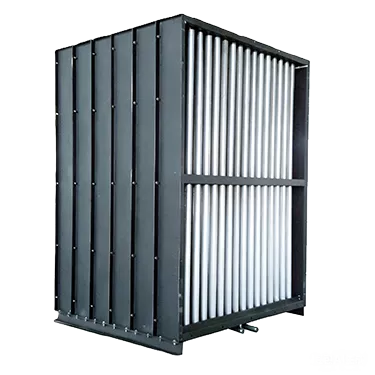
The Detiandixing 2D heat pipe heat exchanger is a high-efficiency heat transfer device based on the principle of phase change heat transfer. Its core realizes directional heat transfer through the evaporation-condensation cycle of the working fluid and gravity drive. It is usually composed of a sealed shell, working fluid and internal gas phase space, with no capillary wick required. The liquid working fluid automatically flows back by gravity to achieve self-sustaining heat transfer.
II. Working Process
1
Heat absorption in the evaporation section: When the hot end is heated, the liquid working fluid absorbs heat and vaporizes to form high-pressure vapor.
2
Vapor transmission: Vapor rapidly flows to the cold end under the action of pressure difference.
3
Heat release in the condensation section: Vapor releases latent heat and condenses into liquid at the cold end.
4
Gravity reflux: The liquid working fluid flows back to the evaporation section along the tube wall under the action of gravity, completing the cycle.
III. Core Advantages

High thermal conductivity efficiency
The equivalent thermal conductivity of phase change heat transfer can reach more than 1,000 times that of copper (10⁴-10⁵ W/m·K).

Zero energy consumption operation
No mechanical pumps or fans, relying entirely on natural circulation.

Simple and reliable structure
No moving parts, with shock resistance, long service life and stable operation.

Strong adaptability
It can be designed into various forms such as straight tube, L-type and loop type to match complex space requirements.

Diverse working media
A wide range of working media can be used for the heat pipe, and different working media are suitable for different temperature ranges.

High isothermality
When the heat pipe is in normal operation, the temperature difference between its evaporation section and condensation section is extremely small, presenting a nearly uniform temperature distribution as a whole. Efficient heat transfer can be achieved with only a 1~2℃ temperature difference between the evaporation section and the condensation section.

Variable heat flux density
The heat pipe can automatically adjust the heat flux density according to the actual heat load. When the heat load is low (e.g., the equipment is running under light load), the evaporation section absorbs less heat, the evaporation amount of the working fluid is small, the vapor generation speed is slow, and the transferred heat is also small. Once the heat load increases (e.g., the equipment is running at high power), the heat absorbed by the evaporation section rises sharply, the working fluid evaporates in large quantities, the vapor flow increases, and the transferred heat increases accordingly, meeting the heat dissipation requirements of the equipment under different working conditions.

Thermal diode characteristic
The 2D heat pipe has the thermal diode characteristic, meaning heat can only be transferred unidirectionally. This is achieved through special designs, such as installing a unidirectional valve inside the heat pipe or skillfully utilizing gravity. When heated in the forward direction, the working fluid evaporates and condenses normally, and heat is transferred smoothly. However, when heated in the reverse direction, the valve closes or gravity prevents the liquid from forming an effective cycle, resulting in almost no heat transfer. This characteristic can be used to prevent heat backflow and ensure the equipment operates as intended.
IV. Typical Application Fields
|
Industry |
Application Scenarios |
|
Industrial Waste Heat Recovery |
– Waste heat recovery from flue gas of boilers and kilns (iron and steel, chemical engineering, building materials) |
|
New Energy and Energy Storage |
– Development of medium and deep geothermal energy (ultra-long heat pipe technology) |
|
Architecture and HVAC |
– Waste heat recovery of fresh air systems (hotels, office buildings) |
|
Environmental Protection and Chemical Engineering |
– Waste heat recovery from chemical tail gas (corrosion-resistant material heat pipes) |
|
Special Environmental Engineering |
– Subgrade cooling in permafrost regions (Qinghai-Tibet Railway, etc.) |
|
Other Innovative Applications |
– Fluidized bed-heat pipe coupled reactor (coal chemical industry) |
V. Service Support
1
Customized design
Provide customized materials, row numbers and structures according to working condition requirements.
2
Technical consulting
Professional team assists in type selection and system optimization.