Product Brief of 3D Heat Pipe Heat Exchanger
I. Product Overview
The 3D heat pipe heat exchanger is a high-efficiency heat exchange device independently developed by Beijing Detiandixing Technology Development Co., Ltd. It breaks through the limitations of traditional 2D heat transfer and achieves multi-directional and multi-dimensional heat transfer through 3D spatial heat transfer technology. Its core adopts gravity or capillary force to drive the circulation of working fluid, featuring both high heat exchange efficiency and flexible installation characteristics, and is suitable for scenarios such as commercial building ventilation systems and industrial waste heat recovery.
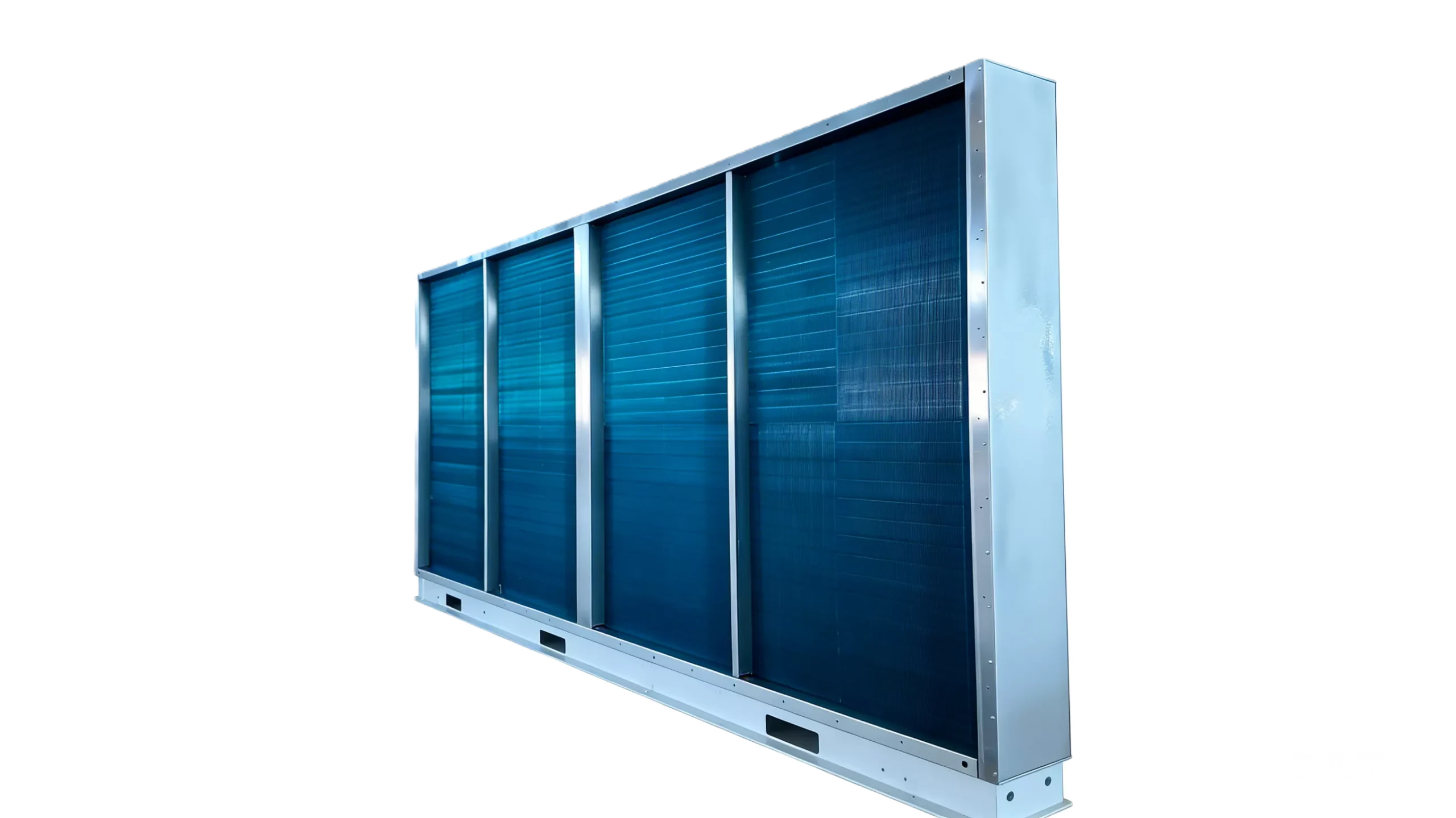
II. Core Characteristics
Two Modes for Driving Working Fluid Circulation
- Vertical installation: Realizes working fluid reflux and evaporation phase change relying on gravity, without external power.
- Horizontal/Inclined installation: The special groove structure on the inner wall generates capillary force to ensure stable circulation of the working fluid.
3D Spatial Heat Transfer
Heat transfer covers radial, axial and spatial heat dissipation, improving heat exchange efficiency.
Diverse Material Options
Features:
Copper tubes: High thermal conductivity (about 385 W/(m·K)), good ductility, and easy to process and form.
Hydrophilic aluminum fins: The surface is treated with hydrophilic process to enhance the diffusion capacity of condensed water, reduce liquid film thermal resistance and improve heat exchange efficiency.
Comprehensive performance: Integrating high thermal conductivity and good corrosion resistance with moderate cost.
Applicable scenarios:
Fresh air systems of commercial buildings under conventional environments, waste heat recovery of hotel air conditioners, etc.
Copper Tubes with Copper Fins
Features:
- All-copper material: Both copper tubes and copper fins are high thermal conductivity materials (copper thermal conductivity is about 400 W/(m·K)) with excellent thermal conductivity performance.
- No aluminum fin corrosion risk: Avoiding the corrosion problem of aluminum under certain working conditions.
- High-efficiency heat recovery: Suitable for scenarios with extremely high requirements for heat recovery efficiency.
Applicable scenarios:
Heat recovery of precision laboratory equipment or any scenarios with extremely high requirements for heat recovery efficiency.
Aluminum Tubes with Hydrophilic Aluminum Fins
Features:
- Aluminum tubes: Lightweight (density about 2.7 g/cm³), low cost, and strong corrosion resistance (especially in neutral or weakly alkaline environments).
- Hydrophilic aluminum fins: Improving heat exchange efficiency in humid environments and reducing the risk of condensation blockage.
- Comprehensive advantages: Light weight, corrosion resistance and low cost.
Applicable scenarios:
Waste heat recovery in humid coastal areas and industrial ventilation systems.
Stainless Steel Tubes with Stainless Steel Plates
Features:
- Stainless steel material: High temperature resistance (up to more than 600℃), corrosion resistance (especially acid, alkali and salt resistance), and high mechanical strength.
- All-stainless steel structure: Avoiding electrochemical corrosion caused by contact between different metals.
- Long service life: Suitable for harsh working conditions, but with relatively low thermal conductivity (about 15 W/(m·K)).
Applicable scenarios:
Waste heat recovery of chemical tail gas, flue gas desulfurization and denitrification and other highly corrosive and high-temperature environments.
III. Technical Parameters
Test Conditions: Ambient temperature 34℃ in summer, air conditioning exhaust air 25℃
| Face Velocity (m/s) | Heat Exchange Efficiency (%) | Heat Exchange Efficiency (%) | Heat Exchange Efficiency (%) | Heat Exchange Efficiency (%) | Air Resistance (Pa) | Air Resistance (Pa) | Air Resistance (Pa) | Air Resistance (Pa) |
| 2 Rows | 4 Rows | 6 Rows | 8 Rows | 2 Rows | 4 Rows | 6 Rows | 8 Rows | |
| 1.0 | 41 | 63 | 76 | 83 | 8 | 16 | 23 | 31 |
| 1.5 | 38 | 59 | 70 | 79 | 17 | 34 | 52 | 58 |
| 2.0 | 37 | 57 | 68 | 75 | 31 | 61 | 92 | 122 |
| 2.5 | 35 | 55 | 64 | 71 | 47 | 95 | 142 | 190 |
| 3.0 | 34 | 52 | 62 | 69 | 68 | 136 | 204 | 272 |
Heat exchange efficiency increases with the number of rows, while air resistance increases synchronously. Selection shall be made according to actual requirements.
IV. Typical Application Scenarios
1
Fresh air systems of commercial buildings
Recovering waste heat from exhaust air, precooling/preheating fresh air, and reducing air conditioning energy consumption.
2
Laboratories and animal houses
Controlling temperature and humidity, recovering waste heat from exhaust air, and ensuring environmental stability.
3
Large hotels and office buildings
Efficiently recovering waste heat from air conditioning systems and improving energy utilization efficiency.
4
Waste heat recovery in coastal areas
Aluminum materials with corrosion resistance are suitable for industrial waste heat recovery in humid environments.

V. Product Advantages
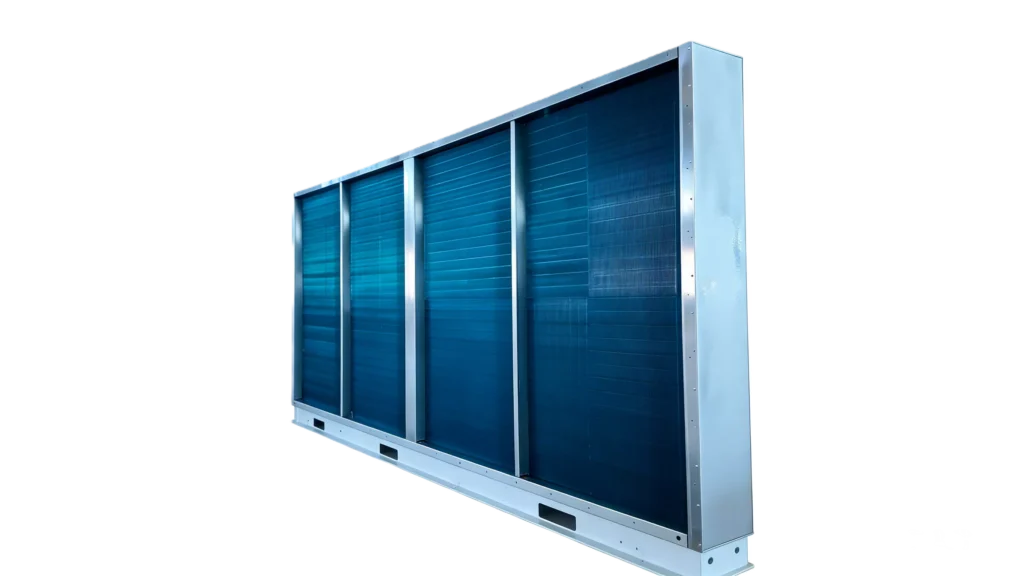
1
High efficiency and energy saving: The heat exchange efficiency of 3D heat transfer technology can reach 60%-80%.
2
Flexible installation: Supporting vertical, horizontal or inclined installation to adapt to complex spatial layout.
3
Long service life design: Corrosion-resistant materials and sealing technology ensure long service life.
VI. Service Support
1
Customized design
Provide customized materials, row numbers and structures according to working condition requirements.
2
Technical consulting
Professional team assists in type selection and system optimization.