

Waste heat is rarely produced right next to where it is needed. The exhaust duct may sit at one end of a plant while the fresh air intake is at the other, or even in a different building. In that case, a standard side-by-side heat recovery unit often cannot be used.
That is why long distance heat recovery needs its own planning. A wrong decision can lead to higher pumping costs, more complex piping, or a system that recovers less heat than expected.
This guide contrasts glycol heat recovery with split heat pipe heat recovery, discusses where each one fits, and lists four things to consider before you choose.
What Makes Long-Distance Heat Recovery More Challenging
When the heat source and the heat sink are close together, the design is simple. Once they are separated, a few things start to matter much more:
- Heat loss: Longer pipes give heat more chances to escape before it reaches the other side, especially if insulation is poor.
- Pressure drop: Longer runs and smaller pipes increase resistance, so the pump may need more energy to maintain the required flow rate.
- Installation: Routing pipes across roofs, walls or shafts takes space and adds cost.
- Control: Loads change through the day and through the seasons, and the system has to keep up.
A remote heat recovery system has to balance these factors, so it helps to look at each technology’s approach.
How Glycol Heat Recovery Handles Long-Distance Systems
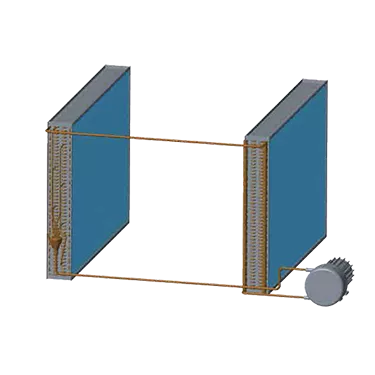
A glycol heat recovery system is a pumped loop. One coil sits in the warm airstream and picks up heat. A pump then sends the fluid through connecting pipes to a second coil in the other airstream, where the heat is released. This layout is also known as a run-around coil, and it works well because the two airstreams never mix.
Glycol is added to reduce the risk of freezing. However, higher glycol concentrations also increase fluid viscosity and pressure drop, which can increase pumping requirements. The concentration should therefore be selected based on the actual minimum operating temperature and system requirements.
The table below lists what to check when a glycol loop is under review.
| Consideration | What to Check |
| Distance | Length and routing of the connecting pipes |
| Heat transfer fluid | Glycol concentration and operating temperature |
| Pumping | Flow rate, pressure drop and pump energy |
| Piping | Pipe diameter and insulation |
| Control | Pump and flow control under changing loads |
| Maintenance | Pump, valves and heat exchanger condition |
When Does a Split Heat Pipe Make Sense
Heat pipes are closed tubes that transfer heat via the evaporation and condensation of a working fluid. In a split heat pipe system, the evaporator and condenser are separated and connected by connecting lines. Heat is transferred through the evaporation and condensation of the working fluid, so no circulation pump is needed for heat transfer.
It is worth a closer look in these situations:
- Separated sections: The exhaust and supply sides cannot be placed next to each other, but cross-contamination must be avoided.
- Passive operation: Removing a circulation pump eliminates the electricity needed for fluid circulation and reduces the number of moving parts.
- Simpler upkeep: Maintenance focuses on the heat-transfer surfaces rather than pumps and valves.
Split heat pipes still have design limits. Distance, elevation and temperature conditions all affect performance, so they should be confirmed with the manufacturer at an early stage.
Glycol or Split Heat Pipe: What Changes from One System to the Other
Both options can connect two separate locations, but they get there in different ways. The comparison below shows how they differ in daily use.
| Factor | Glycol Heat Recovery | Split Heat Pipe |
| Long-distance piping | Requires connecting pipework between the two sections | Separate sections can be connected through the heat pipe system, subject to design limits |
| Circulation | Pump-driven circulation | Evaporation and condensation of the working fluid |
| Pump energy | Required for fluid circulation | Generally not required for heat transfer |
| Layout flexibility | Flexible pipe routing, but requires connecting pipework | Separate sections allow flexible placement, subject to design limits |
| Control | Flow rate can be adjusted through the circulating system | Depends on heat pipe and control design |
| Maintenance | Pumps, valves, fluid and heat exchangers | Mainly heat-transfer surfaces and system condition |
| Best suited to | Projects needing conventional fluid circulation | Projects where passive remote heat transfer is attractive |
Four Things to Check Before Choosing
1. How Far Apart Are the Two Sides?
Measure the actual pipe route, not just the straight-line gap. Bends, height changes and obstacles all add length. Glycol loops can be run over longer routes, while split heat pipes have design limits on distance and elevation.
2. How Much Heat Is Actually Available?
Check the exhaust temperature, airflow and operating hours. A small heat load may not justify a large pumped loop, and a very large one may need a different design altogether.
3. How Much Control Do You Need?
If the load changes a lot, the ability to adjust flow rate is useful, and a glycol loop offers that directly. If conditions are steady, the simpler passive operation of a heat pipe may be enough.
4. What Does the Site Allow?
Space for pumps, insulated pipes and access for maintenance can decide the question on its own. Walk through the site early, since the plan on paper often misses obstacles.
The Right Choice Depends on More Than Distance
Glycol heat recovery can be a practical choice when longer pipe runs, conventional pumped circulation, or adjustable flow control are important. It also fits projects where there is enough space for connecting pipes, pumps, insulation, and related equipment.
Split heat pipe heat recovery can be considered when the two heat-transfer sections need to be separated and passive heat transfer fits the operating conditions. The actual distance, temperature difference, heat load, and system design still need to be checked before making the choice.
In practice, the choice should be based on the distance, heat load, temperature conditions, control requirements, and site layout together rather than on any single factor.
If you are weighing a glycol heat recovery system against a split heat pipe for your project, the team at DTDX can help you review your layout and operating data. Contact us to discuss which option suits your site.eat source you are not sure about, contact us for a realistic assessment.