

Warm, humid air leaving a spray dryer stack means lost energy, but energy that was already paid for by the dryer’s owner.
In many industries, energy use for spray drying is a significant part of the facility’s utility bill, and much of that energy is in the dryer’s exhaust. In this guide, we discuss spray dryer energy use and heat recovery and explain why heat is lost, how it can be recovered, and what to consider before retrofitting a spray dryer heat recovery system.
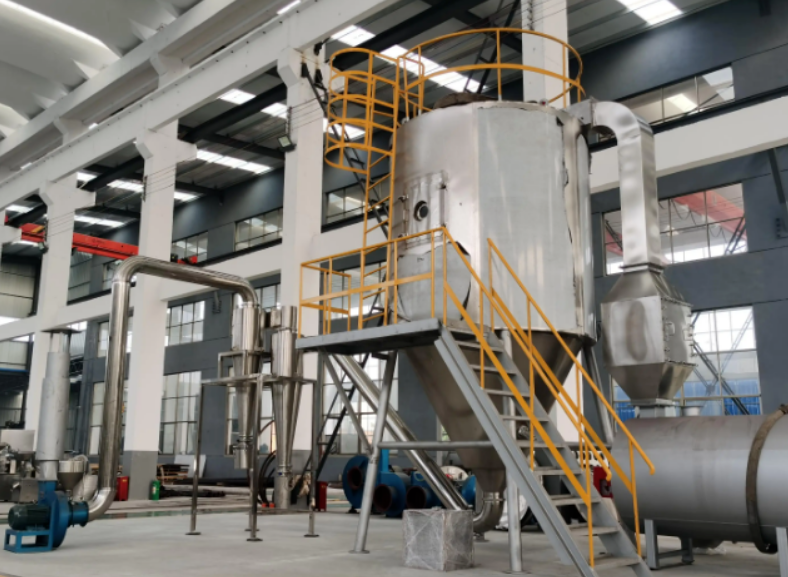
Why So Much Heat Is Lost in Spray Dryer Exhaust
A spray dryer uses hot gas to dry a liquid or slurry to powder. Some of the heat in the air is used to evaporate water and the air leaves the chamber still heated. Depending on product and process exhaust temperature might be as high as 80°C to 100°C in some applications.
That exhaust is hot, hot in two ways. That is what a thermometer reads: sensible heat. The air absorbed the water vapor from the droplets, and with it accumulated latent heat, but this is released only when the vapor condenses.
In practice, most systems recover sensible heat. Cooling the exhaust all the way to its dew point brings condensation and sticky powder, so the recovery has to be designed with some margin.
All this heat goes away when the exhaust flows straight into the atmosphere and the air heater has to heat up the cold fresh air from scratch again. This is why spray drying energy efficiency might look quite poor even when the dryer itself is functioning effectively.
Ways to Recover Heat from Spray Dryer Exhaust
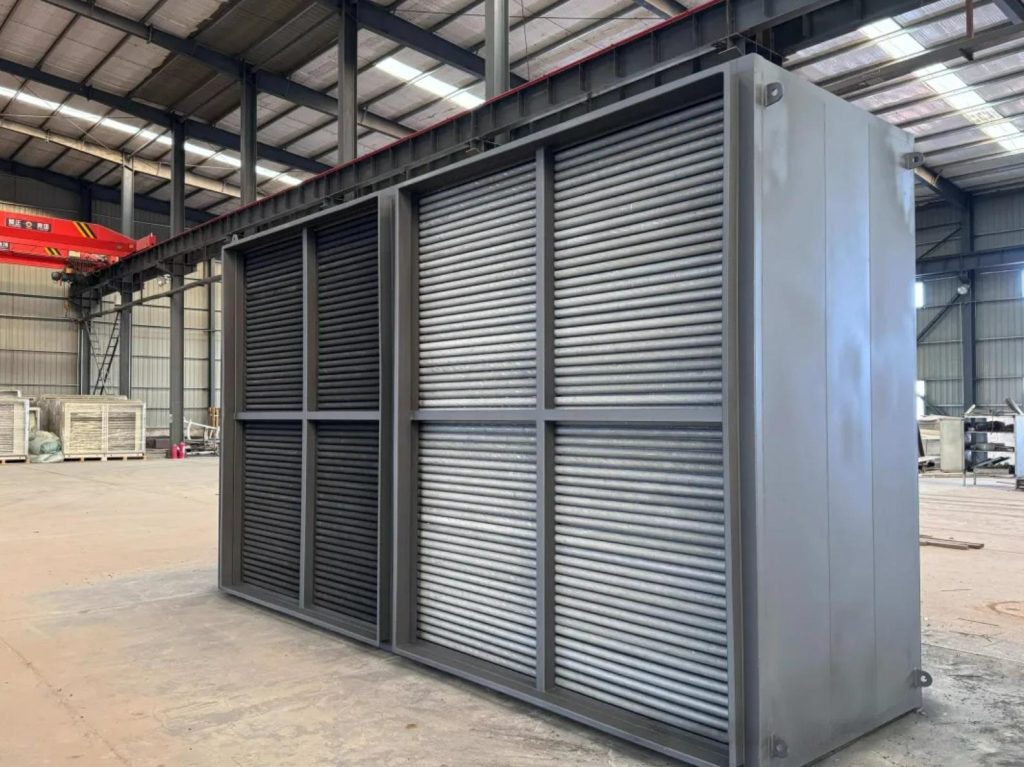
Using Exhaust Heat to Preheat Incoming Air
The most straightforward way is to employ the exhaust to heat the new air before it reaches the main heater. Preheating of air with exhaust gas is one of the most regularly utilized industrial waste heat recovery processes according to the U.S. Department of Energy. That means the heater has less work to do, saving fuel or electricity.
Heating water for cleaning or other processes is another route, but it only pays off if there is steady demand nearby.
How Heat Pipe Heat Exchangers Work
A heat pipe is a sealed tube filled with a tiny volume of working fluid. The fluid evaporates at the heated end, travels to the cool end, condenses and flows back . A large number of these tubes are placed in a frame with the exhaust on one side and the fresh air on the other in a heat pipe heat exchanger. Here’s why that works well for spray dryers:
- No moving parts: No pumps or motors are needed for heat transfer, which helps keep maintenance requirements low.
- Separated airstreams: Exhaust and fresh air do not mix, which is important for food and pharmaceutical powders.
- Flexible layout: Tube rows and fin spacing can be modified for dusty or humid exhaust.
Challenges of Spray Dryer Exhaust Heat Recovery
Spray dryer exhaust is not clean, dry air and there are a few factors to examine before any design is finalized. The ones we see most often are included in the table below.
| Challenge | What to Consider |
| Dust and fine particles | Sufficient fin spacing and access for cleaning |
| High moisture content | Condensation risk and drainage |
| Corrosive exhaust | Suitable corrosion-resistant materials |
| Exhaust temperature | Heat recovery potential and operating limits |
| Pressure drop | Fan capacity and additional energy consumption |
Dust and moisture cause most of the trouble. Installing the exchanger after the dust collector helps a lot, and so does keeping the exhaust above its dew point unless drainage has been planned. Our article on why condensation matters in heat pipe heat exchangers goes into more detail.
Is Heat Recovery Worth Adding to an Existing Spray Dryer?
It depends on the available space, operating conditions, and potential energy savings. A retrofit needs space in the duct work between the dust collector and the stack, plus a fresh air intake that can be run past the exchanger. Four elements that determine your actual savings:
- Operating hours: A dryer running 6,000 hours a year offers more opportunities for energy savings than one operating only occasionally.
- Temperature difference: The hotter the exhaust is than the fresh air, the more heat you can recover.
- Energy price: The same recovered heat is more valuable where fuel is expensive.
- Fan capacity: The extra pressure drop has to be within the capability of your existing fans.
A basic approximation is: recovered sensible heat (kW) = mass flow of exhaust (kg/s) × specific heat (approx. 1.0 kJ/kg·K) × actual exhaust temperature drop (K).
As a rough example, 10,000 kg/h of exhaust cooled by 30°C yields around 80 kW of sensible heat recovery, assuming no condensation. To estimate yearly savings, multiply the recovered heat by operating hours and account for energy prices, heater efficiency, and additional operating costs. Then compare the annual savings with equipment and installation costs to estimate payback.
This is only an example, the true pay-back time will depend on your site and you should analyze it using your real operational data.
Making Better Use of Spray Dryer Exhaust Heat
The heat from the exhaust is often forgotten because it is unseen and has always gone up the stack. But once measured, it’s generally one of the easiest places to minimize energy use without affecting the process itself.
At DTDX, we design and manufacture heat pipe heat exchangers for industrial heat recovery. If you want to know how much your spray dryer exhaust could give back, send us your operating data and we will run the numbers with you.