

When engineers begin to consider heat pipe thermal management options for HVAC systems, the debate normally starts with efficiency metrics. But in real buildings, the more urgent question tends to be simpler: will it actually fit?
A thermal calculation does not cause most projects to fail. They fail because the solution picked does not fit the existing mechanical layout, ductwork geometry or the remodeling budget. This is when the real meaning of the difference between an integrated heat pipe and a split heat pipe starts to show. It is not as a technical argument but as a real engineering decision.
This article covers what sets the two apart structurally, how a separated system works in a typical HVAC scenario, and which heat pipe application cases suit each type best.
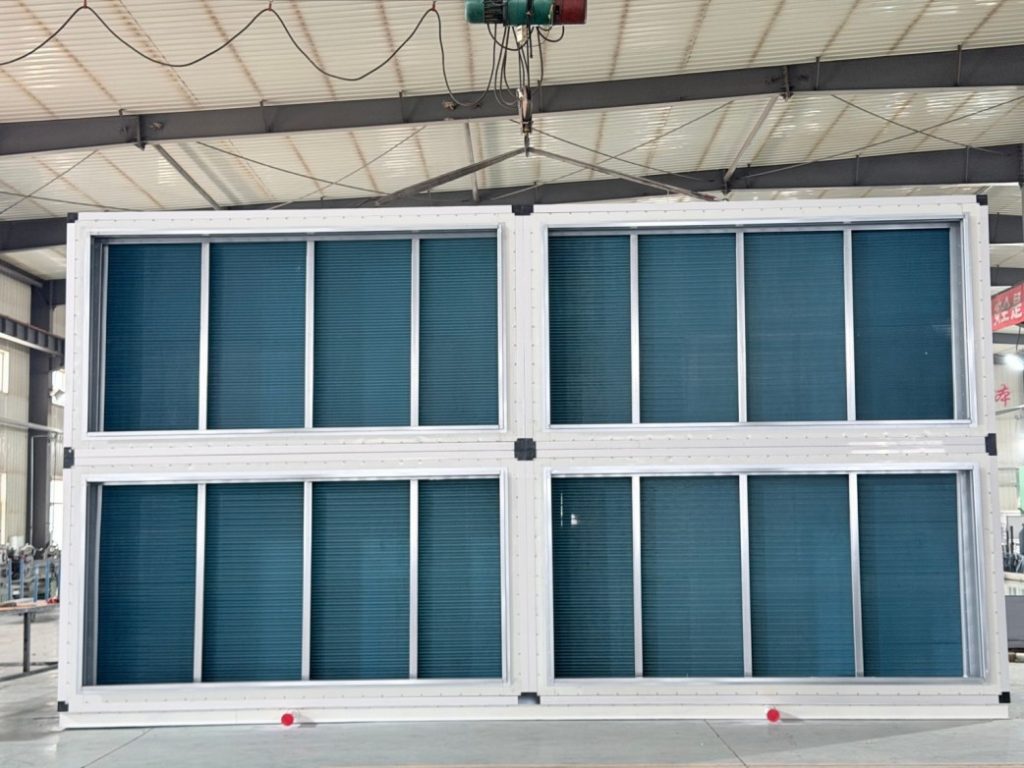
Integrated Heat Pipe vs Split Heat Pipe: What is the Structural Difference?
Conventional integrated heat pipe: It has everything inside a single heat pipe assembly or heat pipe coil. The evaporator and the condenser parts are at opposite ends of the same metal pipe, separated by an adiabatic section (insulating). The two ends of the heat pipe are respectively placed in the heat source and the cold source, and are circulated independently by gravity or capillary action.
Split heat pipe: The evaporator and condenser are built as two separate heat exchangers and are connected by refrigerant lines to make a closed loop. There are two sub-types depending on the return of the condensate:
- Passive (gravity-driven): Operates like a thermosyphon and does not require a pump, but the evaporator must be positioned below the condenser so that the liquid can flow back by gravity.
- Active (pump-assisted): A tiny circulation pump drives the working fluid, abolishing the elevation constraint entirely. The two coils can be separated by up to 30 meters or more.
How Does a Split Heat Pipe Actually Work?
This is easy to imagine with a summer ventilation situation.
1. Evaporator Section (Exhaust Duct): Indoor exhaust air (approx. 24-26°C) flows through the evaporator. The liquid working fluid absorbs cooling energy from the exhaust air of the exhaust and is vaporized.
2. Vapor Transport: The evaporated liquid is transported by the connecting pipe to the condenser (in the fresh air duct).
3. Condenser Section (Fresh Air Duct): Hot outdoor fresh air (approx. 30-35°C) is circulated through the condenser. The vapor releases heat (absorbs heat from the fresh air) and becomes liquid again.
4. Liquid Return: The working fluid returns to the evaporator by gravity or circulation pump so that the cycle is closed.
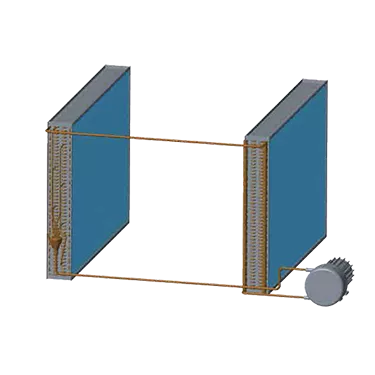
The end effect is that the entering fresh air is precooled before it reaches the main cooling coil, thus directly reducing the air conditioning demand. In winter, the cycle is reversed and heat is collected from exhaust air to pre-warm the fresh air supply.
This kind of heat pipe design is different from the integrated method in the sense that it allows freedom in space. The evaporator and condenser do not need to be located in the same air handling unit. They may be in different mechanical rooms, different floors, or opposing ends of a building—all connected by refrigerant piping.
Core Advantages: Why Engineers Choose Separated Systems
It’s not that a split heat pipe outperforms an integrated one in every measure. But it solves problems that an integrated design simply cannot:
- Thermal design flexibility: The two heat exchangers can be positioned wherever the ductwork is, rather than being constrained by available space inside an existing AHU. This is particularly valuable when retrofitting older buildings.
- No risk of direct air mixing: With the two air streams physically separated and sharing no components, there is no risk of exhaust air mixing with supply air. It is a non-negotiable requirement in hospitals, laboratories, and cleanrooms.
- Real-world energy savings: While integrated systems may achieve slightly higher thermal transfer efficiency in compact configurations, a separated system frequently provides larger overall energy savings since it can be used in configurations where heat recovery would not otherwise be feasible.
- Operational control: Active separated systems can be switched on or off and have their flow rate adjusted. Passive integrated heat pipes have essentially no control capability.
To put it simply, both systems move heat through the same phase-change principle. What differs is where each component lives and how much control you have over the process. The table below summarizes the key differences at a glance:
Comparison Table
| Feature | Integrated Heat Pipe | Split Heat Pipe |
| Structure | Single tube (evaporator + condenser combined) | Two independent coils + connecting pipes |
| Installation | Must fit inside the same AHU | Can span different rooms or floors |
| Height Requirement | Gravity type needs strict elevation difference | Active type has no height restriction |
| Control Flexibility | Essentially none (passive operation) | Start/stop capable, adjustable flow rate |
| Retrofit Adaptability | Limited (requires AHU space) | Excellent (only requires duct access) |
| Extra Power Consumption | Zero | Small pump (~10–50W per unit, active type) |
| Initial Cost | Lower | Slightly higher (piping, pump, controls) |
The fundamental technical challenge is not which technology is more efficient in transferring heat in a laboratory. It is which one can be successfully installed and operated within genuine restrictions of construction.
Typical Application Cases of Split Heat Pipe
Based on the projects we’ve worked on, separated systems consistently prove their value in:
- Commercial mixed-use buildings: Fresh air and exhaust units are frequently located in different mechanical rooms. They are joined by a split heat pipe with no structural modifications to either unit.
- Industrial cleanrooms: Process exhaust may carry contaminants, but its thermal energy can still be recovered, provided the exhaust never contacts the supply air stream.
- Hospitals and laboratories: Absolute air isolation is mandatory, and existing AHUs rarely have room for integrated coils. Separated systems are typically the only viable path.
- Data centers: Server exhaust heat can be used to preheat the winter fresh air. The outdoor air can be used to pre-cool the server room supply. Active separated designs enable the condenser to be located outdoors, away from the IT equipment.
- Retrofit projects: No modification to the existing AHU is needed. The coils mount directly in the ductwork, keeping downtime and disruption to a minimum.
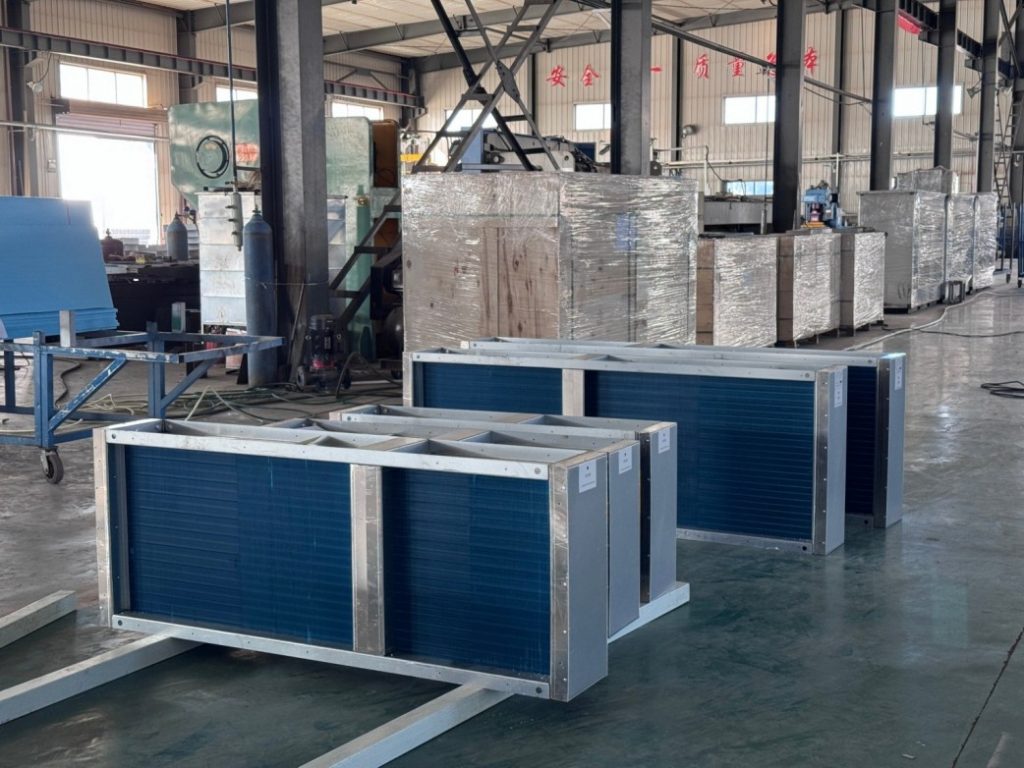
Building Your Ideal Thermal Solution
Both integrated and split heat pipe designs have their place. The better choice depends on your building geometry, air hygiene requirements, and whether you’re starting fresh or retrofitting an existing system.
If your project requires distinct duct locations, rigorous contamination control or restricted space inside an AHU, a split design often provides better overall value, even with a somewhat higher upfront cost.
DTDX offers split heat pipe systems and custom heat pipes tailored to the specific requirements of each project. If you’re working through a heat pipe design challenge and want a second perspective, contact us to get customized system solutions and full-process services for.