

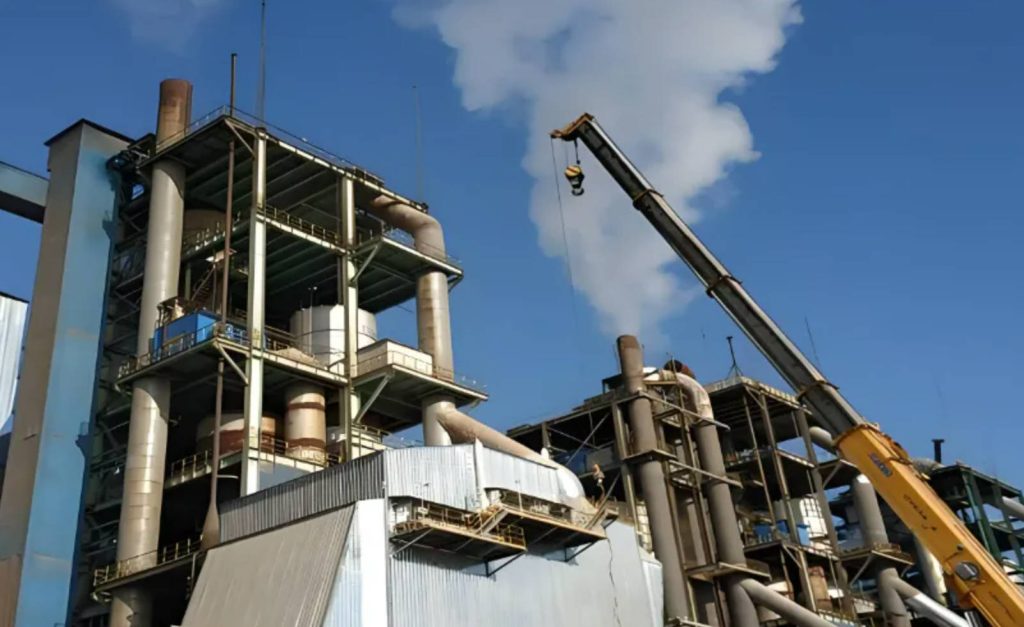
Where is the real bottleneck for waste heat recovery in the alumina industry? It isn’t a lack of thermal energy. It’s that the flue gas is notoriously brutal.
Look at the hard data from modern refinery operations: gas suspension or fluidized bed calciners (FBC) lose a staggering 25% to 35% of their total energy input right through the exhaust stack. For every single ton of alumina produced, the thermal equivalent of 0.3 to 0.5 metric tons of standard coal is lost directly into the atmosphere. Capturing 60% to 70% of this wasted heat would instantly boost the calciner’s thermal efficiency by 8% to 10% and slash your fuel costs.
Yet, many plants historically chose to tolerate this massive energy waste. Why? Because conventional shell-and-tube or plate heat exchangers rarely last a few months in this environment before running into three technical brick walls:
- Aggressive Acid Corrosion: As the flue gas cools, hydrogen fluoride (HF) and sulfur dioxide (SO₂) mix with moisture to form highly concentrated acids. Standard carbon steel can suffer catastrophic pitting and perforation within mere weeks.
- Severe Particulate Clogging: Alumina calcination generates fine, sub-micron dust particles. These particles quickly settle on heat-transfer surfaces, baking into a hard, stubborn crust that chokes gas flow and drops thermal efficiency to near zero.
- The Acid Dew Point Trap: If the tube wall temperature drops even a fraction below the acid dew point, acid condensation accelerates exponentially, destroying traditional waste heat recovery equipment from the outside in.
To crack these tough operational headaches, you don’t need a fragile, overly complex system. You need a technology built on entirely different physics. Enter the heat pipe heat exchanger (HPHE)—a solution engineered not just to endure these harsh conditions, but to thrive in them.
The Phase-Change Edge: How Heat Pipes Solve the Corrosion and Clogging Crisis
A heat pipe heat exchanger (HPHE) changes the entire game by replacing simple metallic thermal conduction with an ultra-efficient phase-change cycle.
Imagine a row of individual, permanently sealed vacuum tubes containing a small amount of working fluid. The lower “evaporator” section sits in the hot flue gas stream, causing the internal fluid to instantly vaporize. This vapor travels to the upper “condenser” section, releases its massive latent heat to the cold medium (air or water), condenses back into a liquid, and flows back down the tube walls to start over.
Because phase-change heat transfer is incredibly efficient, a single heat pipe conducts thermal energy thousands of times faster than a solid copper rod of the exact same size, all while maintaining an almost uniform temperature along its entire length.
For the rugged environment of an alumina refinery, industrial heat recovery system designers like DTDX have engineered specialized configurations that turn these physics into distinct operational advantages:
1. Absolute Isolation of Media (Zero Cross-Contamination)
In an HPHE, the hot flue gas and the clean heated medium are completely isolated by a heavy-duty partition plate. The flue gas stays strictly on its side, and the air or water stays on theirs. Even in the highly unlikely event that a single heat pipe suffers wear over time, there is absolutely no risk of cross-contamination or pressure drops between the two streams.
2. Active Control of Tube Wall Temperatures
This is the ultimate secret weapon against acid corrosion. By precisely adjusting the ratio of the heat transfer surface area between the evaporator and condenser sections, engineers can actively design the tube wall temperature to stay safely and consistently above the acid dew point. If the acid cannot condense, the corrosion cannot start.
3. An Anti-Fouling, Free-Flowing Structure
Unlike tightly packed plate designs, a well-engineered flue gas heat recovery system utilizes straight-through, large-cross-section gas lanes and optimized fin spacing. Because the surface temperature of the heat pipes remains uniformly high, the fine alumina dust cannot bond with moisture to form hard scaling. Any light dust accumulation remains dry and loose, meaning a standard automated steam soot blower or a quick high-pressure water wash during scheduled turnarounds easily restores the system to 100% capacity.
Proven Field Performance: Publicly documented operational records from major industrial installations show that custom-engineered heat pipe waste heat recovery units operating downstream of gas suspension calciners have achieved over 2 consecutive years of continuous operation with zero structural corrosion or clogging, maintaining an equipment availability rate above 98%. (Source: Public enterprise operational records and industrial literature).
Where to Put the Recovered Heat: The Two Most Profitable Pathways
Once you have successfully trapped that thermal energy, how do you deploy it for maximum economic impact? In an alumina refinery, two specific integration points offer the fastest paybacks.
Pathway A: Preheating Pan Filter Wash Water (Steam Substitution)
This is often the lowest-hanging fruit with the fastest return on investment. By installing a heat recovery heat pipe system either right before or immediately after the electrostatic precipitators (ESP), you can drop the flue gas temperature from roughly 350°C (662°F) down to a safer 150°C (302°F).
That captured heat is transferred to the wash water of the horizontal pan filters, raising the water temperature from ambient up to a steady 60°C to 80°C (140°F to 176°F). Hotter wash water significantly improves washing efficiency, leading to more thorough soda removal from the aluminum hydroxide cake. More importantly, it directly displaces massive amounts of expensive, low-pressure live steam previously used to heat that water.
Pathway B: Preheating Calciner Combustion Air (Fuel Savings & Capacity Boost)
Alternatively, the heat pipe energy recovery system can channel the trapped heat back into the calciner’s intake air. Raising the ambient combustion air temperature to 100°C–150°C (212°F–302°F) increases the theoretical flame temperature inside the furnace by 60°C to 100°C.
The operational benefits are immediate:
- Fuel Consumption Drops: Direct fuel usage decreases by 5% to 8%.
- Throughput Scales Up: Overall production capacity increases by 3% to 5% due to better thermal dynamics.
- Enhanced Product Quality: Preheated air ensures a highly uniform temperature distribution inside the furnace, which optimizes the alpha-phase conversion rate of the alumina, yielding a much more stable, high-grade final product.
The Financial Reality: Costs, Savings, and True ROI
Let’s look at the hard numbers. Below is a realistic financial breakdown for a standard industrial heat recovery system retrofitted onto a single fluidized bed calciner processing a typical exhaust volume of 120,000 Nm³/h (equivalent to an annual alumina output of roughly 500,000 tons).
Financial Performance & Payback Matrix
| Financial Metric | Estimated Value (USD / Metric Tons) |
| Total Capital Investment (CapEx) (Includes HPHE unit, ductwork modification, fan upgrades, and installation) | $850,000 – $1,100,000 |
| Annual Energy Savings (Equivalent to recovering 5,000 – 8,000 metric tons of standard coal) | $420,000 – $670,000 / year |
| Annual Operational & Maintenance Costs (OpEx) (Inspections, occasional soot blowing, <5% of initial CapEx) | $40,000 – $55,000 / year |
| Net Annual Cash Savings | $380,000 – $615,000 / year |
| Simple Payback Period | 1.5 to 2.0 Years |
| Environmental Bonus | ~12,000 tons of CO₂ emissions avoided annually |
While a traditional shell-and-tube exchanger might tempt an accountant with a 20% lower initial sticker price, its real lifetime cost is vastly higher. Between the recurring downtime for manual hydro-blasting, frequent tube replacements due to localized pitting, and a thermal efficiency that typically drops by half after year one, a cheap alternative quickly becomes an expensive liability. A dedicated passive flue gas heat recovery device built on heat pipe principles pays for itself cleanly and keeps saving money for years to come.
Conclusion: Stop Letting Profits Evaporate
With global energy regulations tightening and carbon taxes shifting from a future threat to a current balance-sheet reality, industrial operations can no longer treat high-temperature exhaust as mere waste.
A heat pipe manufacturer like DTDX doesn’t rely on overly complex, fragile mechanisms to solve this problem. Instead, we use rugged, time-tested phase-change principles combined with heavy-duty material engineering to eliminate the “Big Three” industrial hurdles: acid corrosion, fouling, and high maintenance overhead.
At the end of the day, every week you hesitate is another week your stack blows potential profit directly into the sky. It is time to run the numbers for your own facility.
Ready to see exactly how much energy you can claw back from your furnace? Contact the engineering team at DTDX today for a comprehensive, custom thermal evaluation and tailored project blueprint.